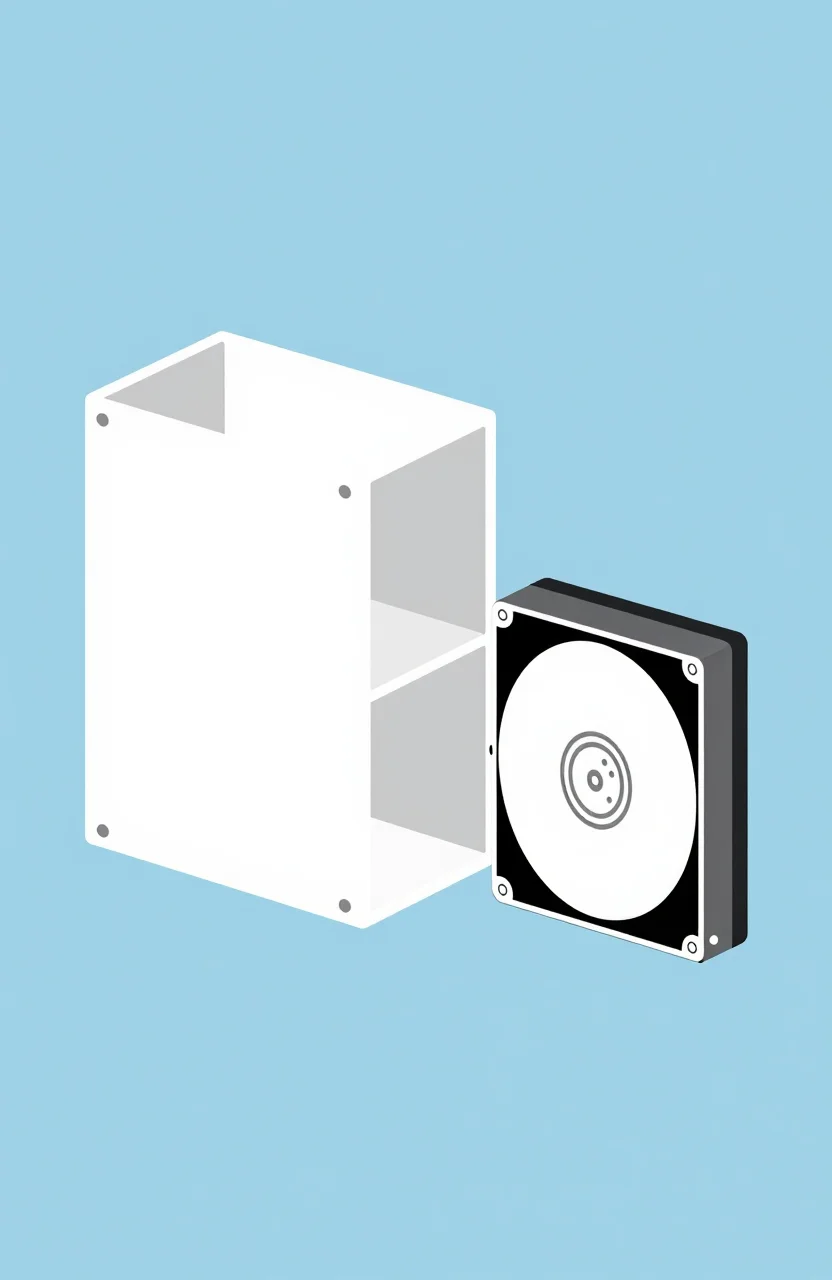
A direct-attached storage enclosure gives you the flexibility to add high-capacity HDD storage to a single computer without the cost and complexity of setting up a full NAS. Dual-bay USB enclosures occupy a practical middle ground: they hold two 3.5-inch drives, connect via USB 3.x, support multiple RAID modes, and stay comfortably under $200 for the enclosure alone. You supply the drives and choose the capacity. This guide covers the three best dual-bay USB DAS options under $200 for 2026, explains JBOD vs RAID 0 vs RAID 1, and points you to the right drives to pair with each enclosure.
What Is a DAS and Who Needs One?
A DAS (direct-attached storage) is a drive enclosure that connects directly to one computer via USB or Thunderbolt. Unlike a NAS, it has no network interface, no embedded operating system, and no remote access capability. You plug it in and the operating system sees the drives as additional local volumes. This simplicity makes a DAS faster to configure than a NAS and requires no router port forwarding, no network configuration, and no NAS software learning curve.
The tradeoff is that only the directly connected machine can access the drives at any given time. For a single-desktop or single-laptop workflow - video editing, photography, local backup, software development scratch storage - a dual-bay DAS is often more cost-effective and simpler than a full NAS. If you need the same storage accessible from multiple devices on your network, a NAS is the better long-term investment. For single-machine use with a budget under $200 for the enclosure, a dual-bay USB DAS is the right tool.
JBOD, RAID 0, and RAID 1: Choosing the Right Mode
Most dual-bay USB enclosures offer a hardware switch that selects the storage configuration without requiring software. Understanding what each mode does is essential before you plug in drives.
JBOD (Just a Bunch of Disks) presents each drive as a completely independent volume. The operating system sees two separate drives. You manage them individually. This is the most flexible option - you can use drives of different sizes, format them differently, and manage each independently. There is no redundancy and no performance boost over a single drive.
RAID 0 stripes data across both drives, writing alternating chunks to each disk simultaneously. This roughly doubles sequential transfer speeds and combines total capacity - two 4TB drives in RAID 0 give you 8TB of fast storage presented as a single volume. The significant risk: a single drive failure destroys all data on both drives since the data is split between them. Use RAID 0 only for non-critical scratch data that is backed up elsewhere.
RAID 1 mirrors all data to both drives simultaneously. Every write goes to both disks. A single drive failure causes no data loss - the surviving drive holds a complete copy. The cost is that usable capacity is half the total raw capacity: two 4TB drives in RAID 1 give you 4TB of protected storage. For backup drives, important project archives, or any storage where data loss is unacceptable, RAID 1 is the correct default. Use the cost-per-GB calculator to model the effective cost of RAID 1 protection vs raw JBOD capacity.
Top Dual-Bay USB DAS Enclosures Under $200
| Enclosure | USB Version | RAID Modes | Max Drive Size | Approx. Price |
|---|---|---|---|---|
| TerraMaster D2-320 | USB 3.1 Gen 1 | JBOD, RAID 0, RAID 1, SPAN | 18TB per bay | ~$80 |
| Yottamaster 2-Bay DAS | USB 3.0 | JBOD, RAID 0, RAID 1, SPAN | 10TB per bay | ~$50 |
| ORICO 2-Bay DAS | USB 3.1 | JBOD, RAID 0, RAID 1 | 16TB per bay | ~$45 |
Enclosure Reviews
TerraMaster D2-320
The TerraMaster D2-320 is the premium pick in this comparison and the most capable enclosure for serious dual-bay DAS use. It uses USB 3.1 Gen 1 (5Gbps), which provides more than enough bandwidth for any pair of spinning HDDs - 3.5-inch desktop drives top out around 200 MB/s sequential, well within the 500 MB/s practical ceiling of USB 3.1 Gen 1. The D2-310 supports drives up to 18TB per bay, covering any consumer or prosumer drive available in 2026. A rotary switch on the rear panel selects between JBOD, RAID 0, RAID 1, and SPAN without requiring software installation on the host computer - a meaningful convenience advantage. The aluminum chassis includes active cooling via a small internal fan, which helps with thermal management when running high-capacity drives under sustained workloads. At approximately $80, it is the most expensive option in this roundup but justifies the premium with broader drive compatibility, active cooling, and cleaner build quality.
Yottamaster 2-Bay DAS
The Yottamaster 2-Bay DAS has been a community favorite for years and remains a strong recommendation at around $50. It uses USB 3.0, offers four RAID mode options via a hardware switch, and has a slim footprint that fits easily on a desk or shelf next to a workstation. The 10TB per bay limit rules out drives above that threshold, but 10TB covers the most common purchase decisions for home users and keeps the total drive cost reasonable. The ProBox uses a plastic chassis with passive cooling - adequate for moderate workloads but worth monitoring if you plan to run high-capacity drives under continuous heavy use without supplemental airflow. For home users who need affordable backup storage or a straightforward RAID 1 mirror, the ProBox delivers exactly that without unnecessary complexity. Pair it with drives from the HDD buying guide for a complete budget-friendly storage setup.
ORICO Dual Bay USB 3.1
The ORICO dual bay USB 3.1 enclosure hits a practical middle ground between the Mediasonic ProBox and TerraMaster D2-320 in both price and capability. It supports drives up to 16TB per bay - a significant improvement over the ProBox's 10TB limit - at approximately $45. RAID mode selection uses a button rather than a rotary switch, which works reliably but feels less tactile and definitive than a physical rotary selector. ORICO provides solid driver support for Windows and macOS. Build quality is plastic with internal ventilation slots and a small cooling fan. For buyers who need 12TB or 14TB drives and cannot stretch the budget to the TerraMaster, the ORICO enclosure is the practical choice.
What Drives to Use in a Dual-Bay DAS
For an enclosure running continuous workloads - daily backups, active video editing scratch storage, around-the-clock operation - use NAS-grade CMR drives. The best NAS hard drives for home guide covers specific WD Red Plus and IronWolf recommendations with capacity comparisons and current pricing. These drives include TLER/ERC support and are built for the kind of sustained operation a DAS enclosure in a RAID configuration will generate during rebuilds and continuous writes.
For lighter workloads - a weekly backup drive, a media archive accessed a few times a month, or overflow file storage - a standard desktop WD Blue or Seagate Barracuda works at lower cost. Use the cost-per-GB calculator to compare drive prices before populating your chosen enclosure. If you are considering shucking external drives to populate the DAS rather than buying bare drives, verify that any shucked drives are CMR before configuring RAID 1 - SMR drives in a RAID 1 mirror can cause extremely slow rebuild times that last many hours or longer. See the dedicated shucking guide for full guidance on verification.
Power and Connectivity Notes
All three enclosures reviewed here require an external power adapter. A pair of 3.5-inch HDDs draw more current than USB can supply alone, so a wall-powered brick is always included. Make sure a free outlet is available near your workstation. On Windows, drives inside a USB DAS may spin down after periods of inactivity depending on system power settings. This is normal and saves energy, but it can cause a brief spin-up delay of a few seconds when accessing the drive after it has been idle. If instant access on first use is important - for example, during a backup window with a tight time schedule - adjust the hard disk power-off timeout in Windows power options to keep the drives awake. For the TerraMaster D2-320 with its active fan, the enclosure will continue drawing power and spinning even when drives are in a low-power state, which some users prefer for always-ready access. For a full network-accessible upgrade path, consider the NAS buying guide when you are ready to move beyond single-machine storage.