How Holographic Data Storage Actually Works
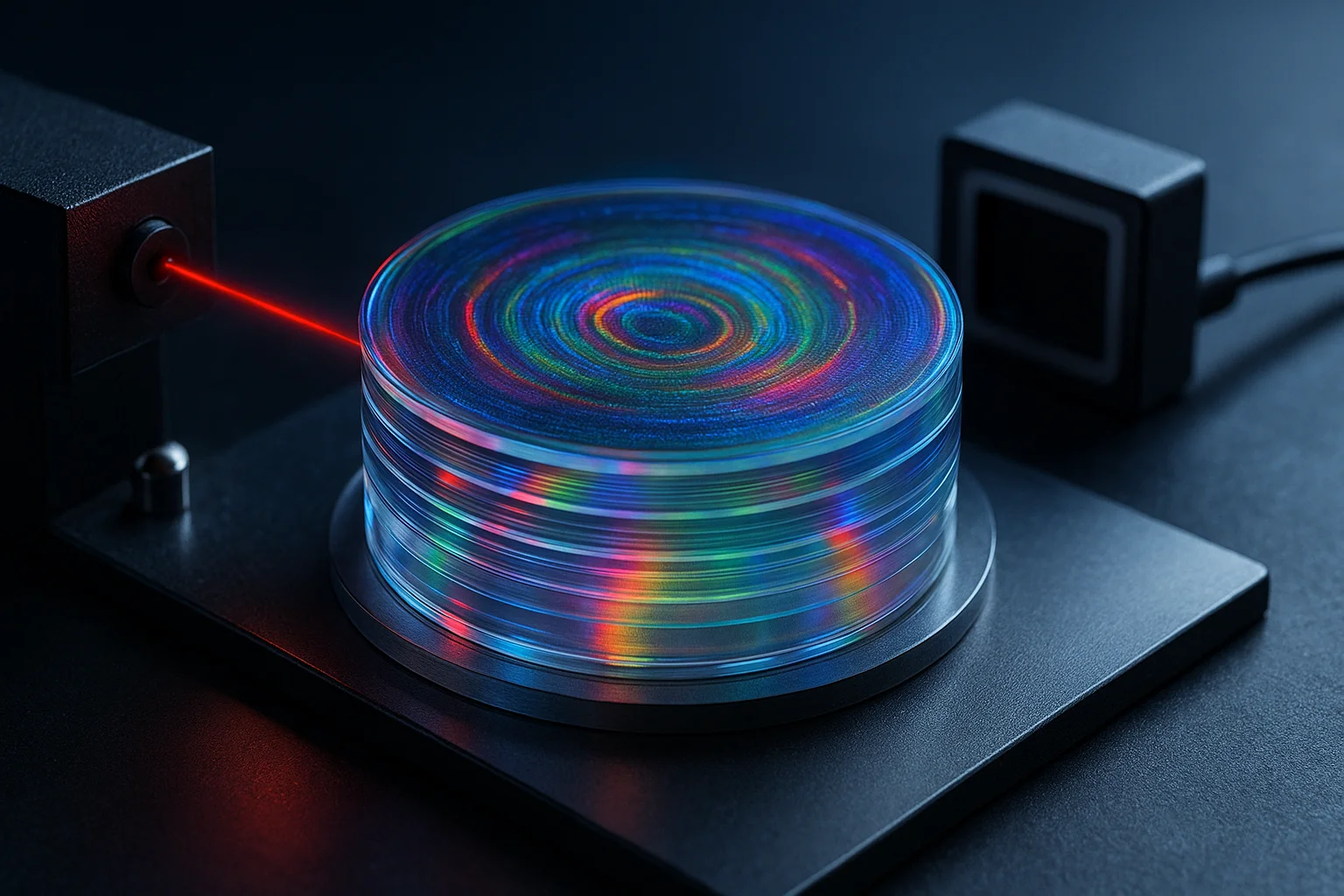
Holographic data storage records information in three dimensions inside a photosensitive medium by using the interference pattern of two coherent light beams. One beam carries the data encoded as a pattern (the object beam) and the other acts as a reference. When both beams intersect inside the medium they create an interference pattern that changes the material's refractive index or absorption locally. Later, shining the reference beam alone reconstructs the object beam so the stored data can be read optically.
This approach differs from surface-based systems because information is stored throughout the volume of the medium instead of only on its surface. Two practical consequences follow: first, a single physical area can hold many overlapping "pages" of data if each page is written with a different reference angle, wavelength, or phase; second, read and write processes are parallel at the page level — whole data pages (thousands to millions of bits) are written or read in one shot rather than bit-by-bit.
Important components in a holographic system include a stable coherent light source (usually a laser), spatial light modulators (SLM) or similar devices to encode data into the object beam, precise optics to control angles and focus, and a photosensitive material optimized for sensitivity, dynamic range, and stability. Practical systems must also handle alignment, error correction, and environmental control.
Why We Still Care: Capacity, Speed, and Longevity Advantages
Holographic storage remains attractive because it promises a combination of properties that current mainstream media struggle to deliver simultaneously. The principal advantages are high volumetric capacity, high page-level parallelism for throughput, and long archival life when the right medium is chosen.
Volumetric capacity means that a single cartridge or disk could potentially store terabytes to petabytes in a compact form factor by multiplexing many holograms in the same volume. Page-level parallelism allows reading or writing of entire pages (for example 1 megabit to 1 gigabit per page, depending on optics) at once, which leads to much higher sustained throughput compared to serial-access media.
Longevity is another selling point. When stabilized in appropriate materials and stored in controlled conditions, volume-stored holograms can resist degradation for decades. This makes holographic media interesting for archival use cases where data must remain readable for long periods without frequent migration.
To make these advantages concrete, consider the following pragmatic list of use cases where holographic storage could excel.
- Cold archives requiring dense capacity and long life - fewer physical cartridges needed for the same data volume.
- High-throughput streaming of large datasets - scientific simulations, remote sensing imagery, or cinematic assets.
- Write-once, read-many distribution media where fast parallel reads are valuable.
The list below summarizes applications that benefit most from holographic traits.
The Technical Barriers Slowing Down Real-World Adoption
Despite its promise, holographic storage still faces several hard engineering and economic hurdles. These barriers explain why the technology has not replaced magnetic or solid-state storage in practice.
Key technical problems include signal-to-noise ratio limits in realistic materials, sensitivity to mechanical/thermal instability, complexity of precise optical alignment, and the need for robust error correction and indexing schemes. Material noise and cross-talk between multiplexed holograms reduce usable density unless advanced materials and recording strategies are used. Optical alignment must be maintained to micron or sub-micron tolerances for reliable readback, which raises cost and reduces robustness in non-laboratory environments.
On the manufacturing and ecosystem side, economies of scale are lacking. Existing storage industries benefit from massive, mature supply chains. For holography to scale, developers must address compatibility with tape/disk standards, create reliable drives, and assure customers of long-term readability — all before volumes drive down costs.
Below is a short, practical checklist of the most impactful engineering challenges to prioritize for a development roadmap.
- Improve material dynamic range and reduce cross-talk through novel photopolymers or photonic crystals.
- Design robust optomechanics that tolerate environmental drift while maintaining alignment.
- Integrate advanced error correction and self-calibration routines to counteract signal degradation.
- Standardize form factors and interfaces to allow ecosystem adoption and manufacturing scale.
Each step is a potential engineering milestone that materially improves viability.
Recent Breakthroughs Bringing Holography Back Into the Spotlight
Research groups and startups have made progress on several fronts, closing the gap between laboratory demonstrations and practical devices. Notable technical advances include improvements in recording materials, higher-resolution spatial light modulators, more efficient multiplexing algorithms, and machine-learning-assisted reconstruction and error correction.
Material science improvements focus on increasing sensitivity and dynamic range while ensuring long-term stability. New photopolymers and doped crystals reduce shrinkage and noise, which increases the number of holograms that can be multiplexed per volume. On the electronics side, higher-resolution SLMs and faster readout sensors enable larger page sizes and higher data rates.
Below is a compact comparison table highlighting differences between holographic storage and two common alternatives to help readers quickly assess where holography may offer unique value.
| Characteristic | Holographic Storage | Magnetic Tape / HDD | Solid-State (SSD) |
|---|---|---|---|
| Typical density | Potentially very high - volumetric petabytes per cartridge | High linear density but surface-limited | High planar density but costlier per TB at very large scales |
| Throughput | High page-level parallel throughput | High sequential throughput for tape, moderate for HDD | High random and sequential throughput |
| Latency | Moderate - optical read alignment adds latency | High for tape, moderate for HDD | Low |
| Longevity | Potentially decades with right medium | Decades for archival tape | Variable - SSD retention shorter for long-term cold storage |
This table is a simplified synthesis to help decision makers weigh trade-offs. Real-world performance depends on the specific implementation and operating conditions.
What a Future With Holographic Storage Could Look Like
If remaining technical challenges are solved and an ecosystem forms, holographic storage could find a practical niche rather than outright replacing existing systems. Expect hybrid architectures where holography complements tape, disk, and cloud: ultra-dense cartridges for deep archives, holographic read stations for rapid bulk recovery, and SSDs/HDDs for hot and active data.
From an operational standpoint, transition steps are actionable. Organizations can begin by evaluating holographic prototypes for archival validation, running parallel writes to both established media and holographic test cartridges to assess integrity and retrieval workflows. Software interfaces should expose holographic media as a tier in hierarchical storage management while preserving existing backup and cataloging processes.
Below is a short practical roadmap organizations could adopt if they decide to pilot holographic storage.
- Run small-scale archival pilots with controlled datasets and periodic integrity checks.
- Develop import/export tools to integrate holographic reads into existing backup systems.
- Monitor bit error rates and environmental impacts over time to validate life-expectancy claims.
- Scale gradually while negotiating vendor guarantees for media readability and drive support.
This roadmap focuses on low-risk integration and measurable milestones.
These steps allow institutions to gain confidence without disrupting current operations. If the technology continues to improve, holographic storage could become an essential layer in multi-decade digital preservation strategies.