Not all SD cards handle 4K video. That is the blunt truth most buyers discover after they have already missed shots. A card rated for regular photo shooting can lock up mid-clip when a GoPro or DJI drone pushes sustained 4K data rates - and the result is either dropped frames or a hard stop that kills your recording. This guide cuts through the spec noise and focuses on what actually matters for 4K video, drone footage, and action cameras in 2026.
Speed Class Ratings That Actually Matter for Video
Card manufacturers use several overlapping speed rating systems, which creates real confusion at the point of purchase. Here is what you need to know for video work specifically:
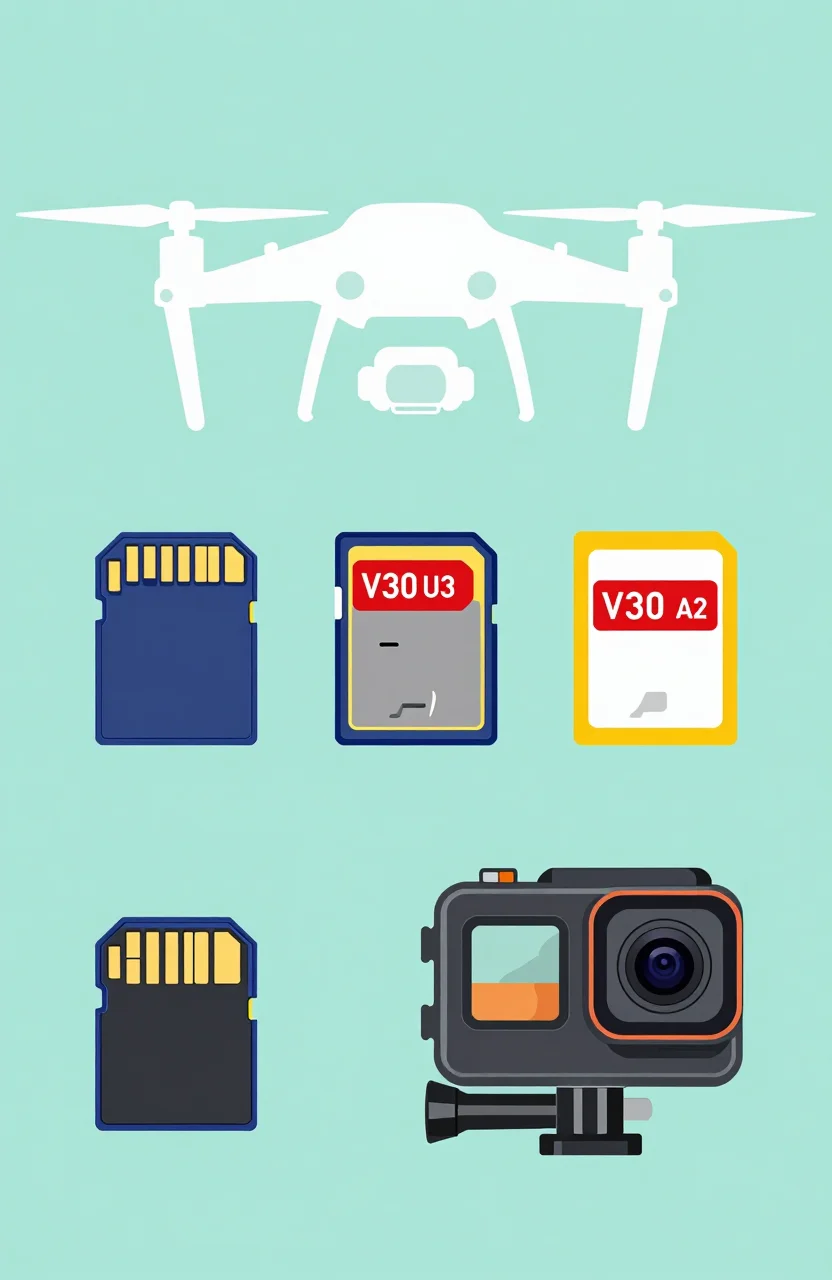
- Video Speed Class (V30, V60, V90) - The most relevant spec for video. V30 guarantees a minimum sustained write speed of 30 MB/s, sufficient for most 4K shooting at standard consumer bitrates. V60 and V90 are for high-frame-rate 4K and 8K RAW - overkill for most users.
- UHS Speed Class (U1, U3) - U3 guarantees 30 MB/s minimum write, equivalent to V30 in practice. U1 covers only 10 MB/s minimum, which is not enough for 4K. Look for the number 3 inside a U shape on the card label.
- Application Performance Class (A1, A2) - Designed for smartphone apps and random IOPS performance. A2 cards have stronger random read/write specs than A1. Useful in drones and phones that access many small files simultaneously, but secondary to V30/U3 for pure sequential video recording.
For 4K at typical consumer bitrates (100-200 Mbps), a V30/U3 card is the minimum viable spec. Higher bitrates - RAW or All-Intra codecs from professional bodies - push you toward V60 or above. Always check your camera manufacturer's recommended card class before buying; some explicitly require certain ratings to guarantee stable recording.
For a complete explanation of all SD card classes and form factors, our comprehensive SD card guide covers every rating system in detail.
Full-Size SD vs microSD: Which Format Do You Actually Need
The form factor question is simpler than it looks. Most mirrorless cameras and DSLRs use full-size SD cards. Drones (DJI Mini 4 Pro, Air 3, Mavic series), action cameras (GoPro Hero series), and smartphones use microSD.
MicroSD cards work in full-size SD slots via a passive adapter with zero performance loss. So if you are buying one card for both a GoPro and a laptop card reader, a microSD with adapter is the more flexible and often cheaper choice. If your primary device is a mirrorless camera with a native full-size SD slot, go native for the best physical contact reliability - adapters introduce one more potential failure point in the chain.
One rule applies regardless of format: adapters from reputable brands only. Off-brand adapters can cause intermittent read errors or fail to seat properly in reader slots - not a risk worth taking when your footage is on the line.
Best SD Cards for 4K Video and Drones in 2026
All four cards below are V30/U3 rated or better, validated by camera and drone communities for sustained 4K recording workloads. They are available from reputable sellers and carry manufacturer warranties worth something if a card fails.
SanDisk Extreme PRO SDXC 128GB - Top Full-Size Pick for Mirrorless Cameras
The SanDisk Extreme PRO SDXC 128GB delivers up to 200 MB/s read and 140 MB/s write, with V30/U3 class rating. It is the reference card that most professional camera reviewers use as their baseline benchmark, which tells you it holds up under sustained 4K write pressure. Works reliably with Sony Alpha, Canon R series, Nikon Z series, and Fuji X bodies. At 128GB, you fit roughly 75-90 minutes of 4K/60fps footage depending on codec and bitrate - enough for most shooting sessions without a swap.
SanDisk Extreme PRO SDXC 256GB - When You Cannot Swap Cards Mid-Session
Same performance spec as the 128GB, the SanDisk Extreme PRO SDXC 256GB doubles the capacity. If you are shooting events, travel documentaries, or multi-hour sessions where stopping to swap cards is not an option, the 256GB version removes that concern entirely. Price-per-gigabyte also drops versus buying two 128GB cards, and you eliminate the card-swap moment where something can always go wrong.
SanDisk Extreme microSDXC 256GB - Best for Drones and GoPro
The SanDisk Extreme microSDXC 256GB is purpose-built for DJI drones, GoPro Hero series cameras, and Android phones used in action shooting. Rated A2/V30/U3, it handles the thermal stress of outdoor recording sessions - heat is real inside a drone during summer flights. A full-size SD adapter is included. At 256GB, it covers a full day of 4K drone footage across multiple battery swaps without touching a laptop. The A2 rating also benefits DJI systems that read app and cache data from the card during operation.
Lexar Silver Plus microSD 256GB 2-Pack - Best Value for High-Volume Shooters
The Lexar Silver Plus microSD 256GB 2-pack delivers 205 MB/s read and 150 MB/s write at V30 - specs that genuinely compete with the SanDisk Extreme PRO. Buying two cards at once makes financial sense if you shoot regularly: one card records while the other backs up, which halves your turnaround time in the field. At 512GB total across two cards, this is the practical choice for event videographers or drone pilots running multi-battery sessions day after day.
Capacity Planning for 4K Footage: A Quick Reference
Before buying, it helps to know how much footage your card will actually hold. These figures vary by camera and codec but serve as a solid planning baseline:
| Resolution / Codec | Approx. per Minute | 128GB holds | 256GB holds |
|---|---|---|---|
| 4K/30fps H.264 ~100 Mbps | ~750 MB | ~170 min | ~340 min |
| 4K/60fps H.265 ~150 Mbps | ~1.1 GB | ~116 min | ~232 min |
| 4K/60fps All-Intra ~400 Mbps | ~3 GB | ~42 min | ~85 min |
Leave 10-15% headroom on any card - flash storage slows down as it approaches capacity, which can cause frame drops on sustained-write workloads at exactly the wrong moment.
Buying from Reputable Sellers: The Counterfeit Card Problem
Fake SD cards are a persistent and serious problem on online marketplaces. A counterfeit 256GB card reports 256GB to your device but silently corrupts data or drops frames once it reaches its actual NAND limit - often just 16GB or 32GB inside a relabeled shell. The consequences range from lost footage to corrupted camera firmware.
Safe buying channels: Amazon sold and fulfilled directly by Amazon, authorized retailers like B&H Photo, Adorama, or Best Buy, or manufacturer websites. Avoid any third-party marketplace seller offering a major brand at dramatically below-market prices. A genuine 256GB SanDisk Extreme PRO does not sell for $12. If it does, it is fake hardware.
Check our SD card section for current pricing benchmarks across major brands and capacities - if a card's listing price is far below the average, treat it as a warning. Once you have your footage, protecting it matters just as much as capturing it: our guide on how to back up SD card data covers the safest and most reliable methods to keep your recordings safe long-term.