Flash and spinning disks still run the world you can buy today. In labs and pilot projects, though, researchers pack bits into DNA strands, etch data into quartz glass, and test optical tricks that promise centuries of retention in a sugar-cube of media. Those ideas matter for anyone who thinks about archives beyond the next SSD refresh cycle.
This overview separates what is shipping, what is prototype, and what remains slideware. It also ties the long-term story back to practical choices you make now: when to keep cold data on HDD or tape-like workflows, when cloud cold tiers win on price, and how experimental media compares with nearer-term optical research such as holographic storage.
Why labs chase denser, longer-lived media
Data centers drown in cold data: sensor logs, medical images, compliance archives, training corpora. Keeping everything on power-hungry flash is expensive. Keeping it on HDD farms works, but racks, replacements, and migrations never stop. Emerging media sell a different promise: extreme density plus retention measured in decades or centuries with near-zero idle power.
For a home or small-business reader, the near-term implication is strategic, not shopping-cart. You still buy SSDs and HDDs. You still compare SSD price per GB and external HDD pricing. The research tracks remind you that "future-proof" usually means good migrations and formats, not waiting for DNA USB sticks.
Hyperscalers fund much of this work because a one-percent cut in cold storage cost or power shows up on a billion-dollar bill. That funding is why prototypes move from university benches into warehouse pilots faster than they used to, even when retail shelves stay empty.
DNA, glass, and optical approaches in plain language
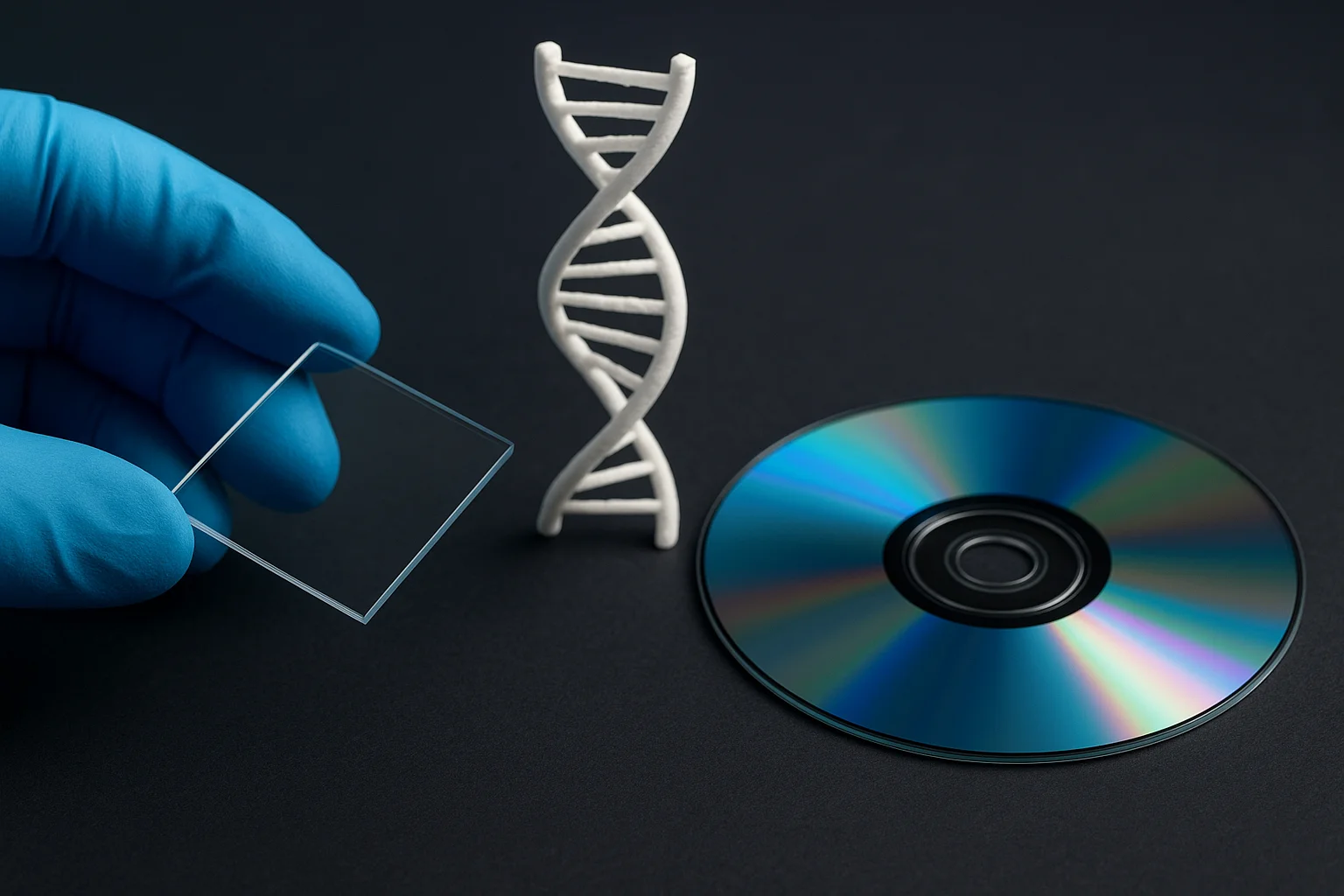
DNA storage encodes bits as sequences of bases. Synthetic DNA is dense and stable when kept dry and cool. Writing and reading still rely on specialized chemistry and sequencing, so latency is closer to archival batch jobs than random SSD I/O. Startups and hyperscalers run pilots; consumer products are not on shelves. Think of it as a mail-order vault: you ship a dataset, wait, and retrieve later, not as a boot drive.
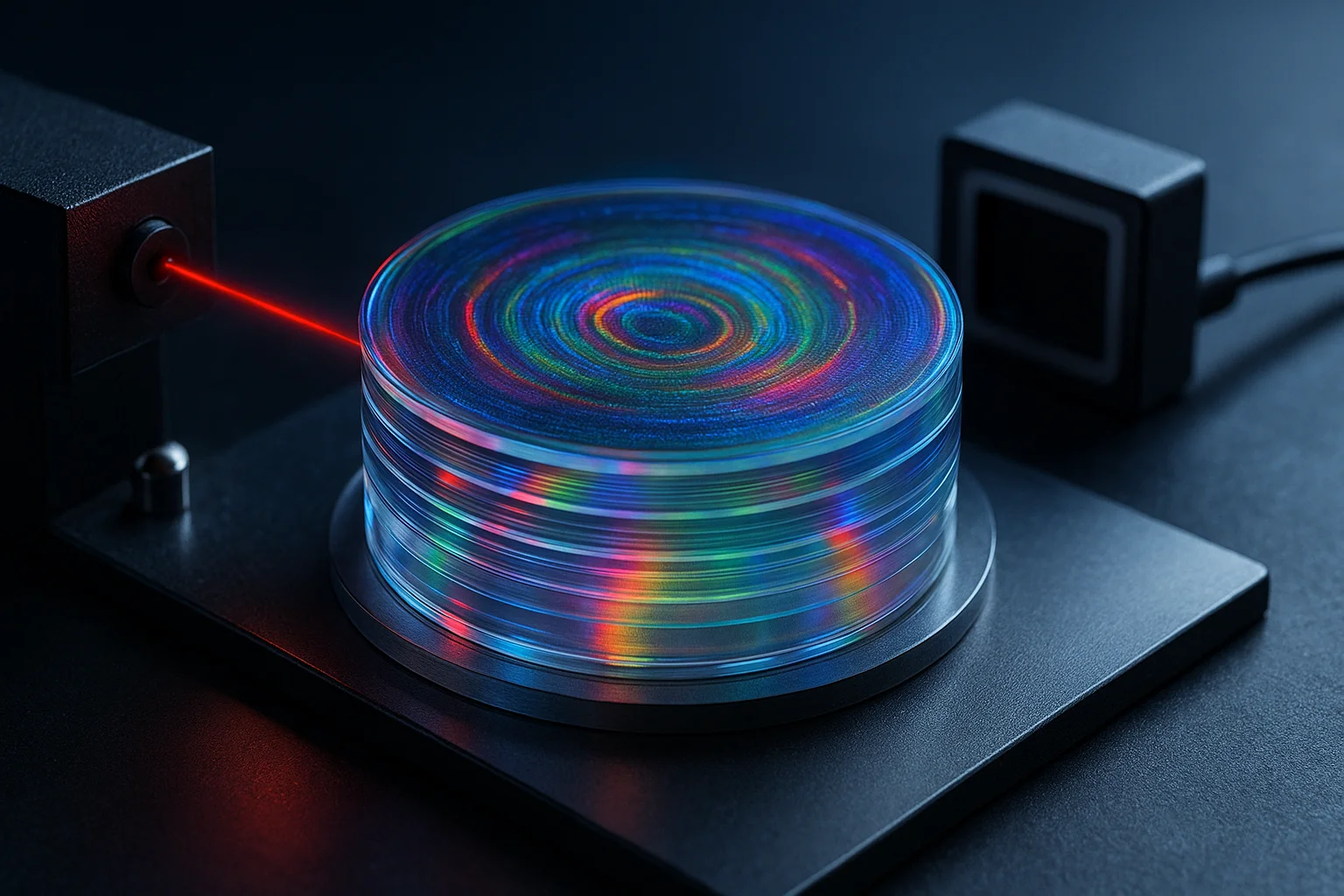
Glass or fused silica storage writes microscopic modifications inside quartz with lasers. Microsoft and partners have shown Project Silica-style prototypes aimed at cold archival. The pitch is durability against heat, flood, and electromagnetic events that ruin tapes and disks. Access remains sequential and infrastructure-heavy. Libraries would need robots and readers more like tape silos than USB docks.
Five-dimensional optical storage and related femtosecond-laser techniques store data in nanostructures inside glass or crystal, sometimes marketing centuries of life. Holographic concepts store pages of data in volume media rather than on a surface. Progress is real in papers and demos; cost, write speed, and standardization still block everyday use. Treat press releases as research milestones, not buy guides.
What about quantum and molecular ideas?
Quantum storage headlines usually describe quantum memory for networking, not a Dropbox replacement. Molecular and protein-based schemes appear in journals with similar caveats: fascinating density math, unfinished engineering. For planning purposes, bucket them with DNA and glass as long-horizon archival science.
Trade-offs that still decide real deployments
Density without throughput is a vault, not a filesystem. Archives need write bandwidth for ingest, integrity checks, and eventual migration. Emerging media often win on shelf life and watts at rest while losing on random access and tooling maturity. Error correction, format standards, and vendor lock-in matter as much as petabytes per gram.
Energy narratives cut both ways. Media that sits unpowered for decades can beat always-spinning HDD libraries on carbon, a theme we also track for conventional flash in green storage and SSD footprints. Manufacturing the exotic media and the writers may erase those gains until processes scale. Always ask for full lifecycle numbers, not only idle watts.
Security and privacy change too. A glass platter in a cave is hard to hack remotely and hard to erase quickly. Chain-of-custody and key management still apply; durable media without key hygiene just preserves leaks longer. Pair any archival dream with the same encryption discipline you use on today's disks.
What you should do while waiting for lab tech
Run a boring archive well. Follow 3-2-1, keep offline copies, and test restores. Use cloud cold tiers or local HDDs for bulk, priced via our cloud vs local analysis. Prefer open formats and documented folder layouts so a future migration to glass or DNA-as-a-service does not require archaeology.
Watch standards bodies and hyperscaler blogs for production SLAs, not only density records. When a technology offers commercial write/read services with published durability numbers, revisit. Until then, treat DNA and glass as signals that cold storage economics will keep shifting, while your job is surviving the next decade with media you can actually buy on HDD and SSD shelves.
If you manage a studio archive, schedule a yearly format review: which codecs still open cleanly, which catalogs need export, which disks are leaving warranty. That operational rhythm prepares you for whatever media arrives next.
How the pieces compare at a glance
Flash: fast, finite program/erase life, ideal for hot data. HDD: cheap capacity, mechanical wear, fine for warm/cold if refreshed. Tape: still the workhorse of big archives, sequential and mature. DNA/glass/advanced optical: extreme density and longevity in prototypes, slow and specialized. Holographic research: overlaps the optical long game with uneven commercial history.
If you design a home lab or small studio archive today, buy reliability and process, not science fiction. Keep an eye on emerging storage because it shapes what vendors will pitch in five to fifteen years. Your photos and tax records still need a working backup tonight.